Statistical genetics & target discovery
Common and rare-variant association, fine-mapping, colocalization and phenome-wide scans across exome and proteomics cohorts, used to find causal genes and judge which ones are worth a drug program.
Associate Manager, Genomics & Health Data Mining·Regeneron Genetics Center
People who carry rare natural genetic variation that protects them from disease are some of the best guides we have to new medicines. I use statistical genetics and multi-omics to find such links, and to follow that evidence from variant to gene to target.
I'm an Associate Manager in Genomics & Health Data Mining at the Regeneron Genetics Center. What excites me about this line of work is that genetics lets us study a ton of the causal mechanisms of disease, fixed (germline) or otherwise acquired (somatic), directly in people, and that such findings can nominate exciting new medicines for patients.
Most of my work is translational genetics: starting with association testing across large sequencing and proteomics cohorts, then using methods like statistical fine-mapping and colocalization to identify the causal genes driving those signals. I also pair this with phenome-wide analyses and machine learning to weigh the evidence for a target, including where else it might help and where it might cause harm, and I work closely with our therapeutic-area and preclinical colleagues to test those hypotheses.
I trained as a physicist, and I still approach biology the same way (though it doesn't always apply): looking for ways to reduce a problem to a system of variables and equations that can be tested. During my PhD in Applied Physics at the University of South Florida with Dr. Ghanim Ullah, I combined biophysical modeling of synapses with single-cell and spatial multi-omics to map cell-type-specific mechanisms of synaptic dysfunction in Alzheimer's disease.
Along the way I built reference-mapping and interpretable deep-learning pipelines for target discovery at Cajal Neuroscience, and, as a PhD intern at RGC, worked on linking GWAS loci to drug-response mechanisms in large-scale single-cell perturbation data.
Outside work you'll find me playing soccer, running, reading or gaming.
Common and rare-variant association, fine-mapping, colocalization and phenome-wide scans across exome and proteomics cohorts, used to find causal genes and judge which ones are worth a drug program.
snRNA-seq, scATAC-seq and spatial transcriptomics, co-expression and regulatory networks, and interpretable ML for cell states in neurodegeneration.
Biophysically detailed models of intracellular Ca²⁺ signaling and neurotransmitter release that turn molecular hypotheses into testable predictions.
Statistical genetics and machine learning for target discovery: association testing, fine-mapping and colocalization across large exome and proteomics cohorts, phenome-wide analyses for efficacy and safety, and portfolio-level views of the human genetic evidence behind targets across therapeutic areas.
Worked on linking GWAS loci to drug-response mechanisms in the Tahoe-100M single-cell perturbation atlas, asking how germline variants shape cellular responses to pharmacological intervention.
University of South Florida · Ullah Lab
Built biophysical models of presynaptic Ca²⁺ signaling and single-cell multi-omics pipelines to map cell-type-specific mechanisms of synaptic dysfunction in Alzheimer's disease. Led the lab's genomics subgroup and mentored three trainees.
Developed interpretable deep-learning pipelines (scArches / expiMAP) for reference mapping of single-cell data, informing target prioritization for Alzheimer's and Parkinson's disease programs.
University of South Florida · Uversky Lab
Studied intrinsic protein disorder in Ebola and Marburg virus proteins and its implications for virulence.
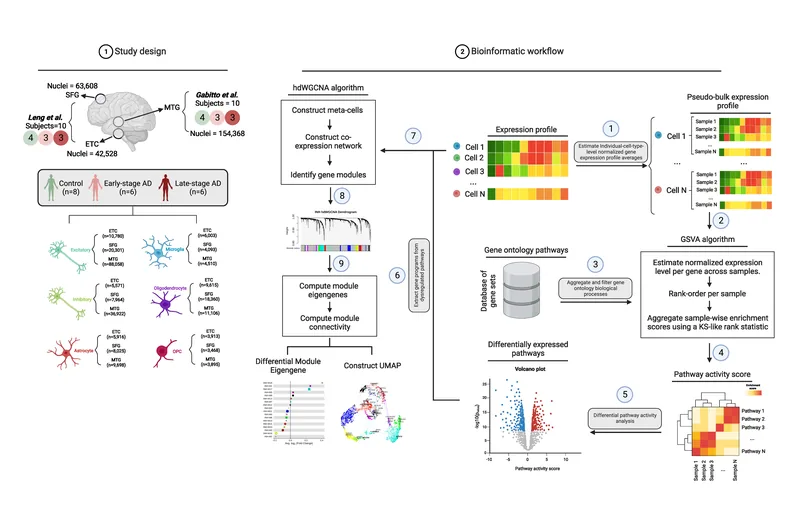
Integrating pathway activity with single-nucleus co-expression networks across three brain regions shows that differential expression alone misses much of Alzheimer's biology, and implicates astrocytes and microglia in calcium, glutamate, lipid and TOR signaling.
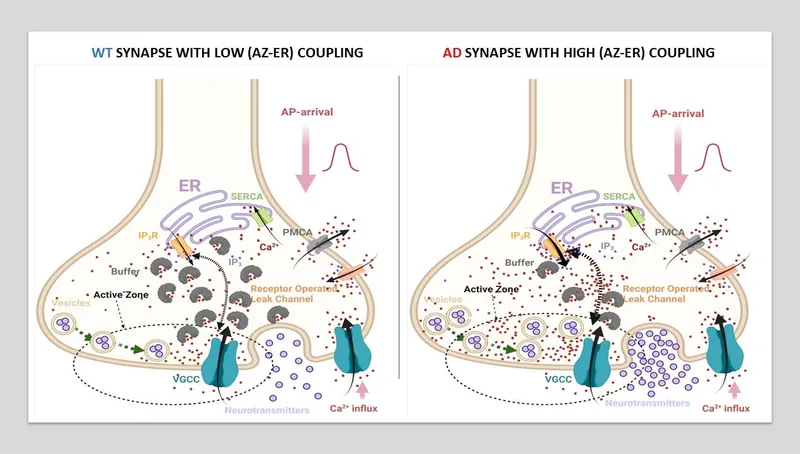
A detailed biophysical model of hippocampal synapses shows that IP₃R-driven ER Ca²⁺ release raises release probability, enhances short-term plasticity and desynchronizes neurotransmission in FAD.
Started as Associate Manager in Genomics & Health Data Mining at the Regeneron Genetics Center, working on the statistical genetics and multi-omic analyses that help us find and prioritize new drug targets.
This summer I’m joining the Regeneron Genetics Center as a PhD intern with the Neuroscience & Ophthalmology Therapeutic Area Genetics team, working with Ernst Mayerhofer and Sahar Gelfman. The project connects GWAS hits to drug-response mechanisms in the Tahoe-100M perturbation atlas: how do germline variants found at population scale play out at the cellular level, and how do they interact with pharmacological intervention?
Gave a talk at the annual meeting of Synapses Under Stress (RU 2795), hosted by Prof. Jürgen Klingauf at the University of Münster, Germany: Alzheimer’s Disease-associated Intracellular Calcium Dyshomeostasis Leads to Impaired Presynaptic Function. I shared how disrupted Ca²⁺ signaling in familial AD reshapes neurotransmitter release and plasticity in silico, and how Aβ-mediated cation pores modulate presynaptic Ca²⁺ dynamics and exocytosis.
Honored to receive the Society for Neuroscience Trainee Professional Development Award for SfN 2024, recognizing scientific merit and excellence in graduate research. Thanks to my PI, Prof. Ghanim Ullah, for his guidance and support.